Forge of Empires: Build a City
- 4.2
- Rating
- 10.00M
- Installs
- Free
- Price

 Analysis by App-foxy
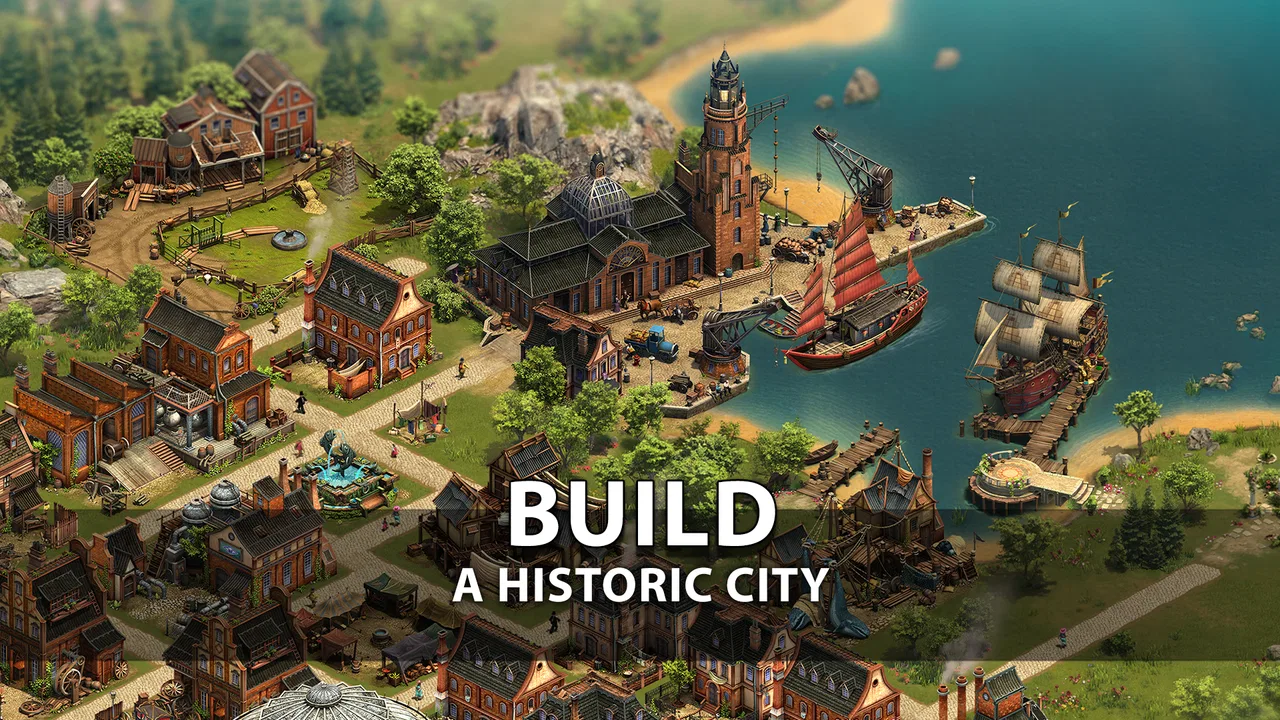
Forge of Empires is the kind of strategy game I open for a few minutes and then realize I have been planning my next upgrade for much longer than expected. Developed by InnoGames GmbH, it combines city building, resource management, research, and territorial expansion in a way that feels more deliberate than a simple construction timer game. My overall view is positive: it is a rewarding long-term strategy experience, but it asks for patience and regular attention rather than delivering instant action.
The central appeal is watching a small settlement grow through different stages of civilization while making choices that affect its economy and military position. I liked that progress is not only about placing attractive buildings. Every decision has a practical consequence. A new production building may improve income, but it also uses valuable space. Research can open useful options, yet spending resources in one direction may delay another development. That constant balancing gives the game its personality.
Building a city that reflects your decisions
At the beginning, the experience is easy to understand. I placed buildings, collected goods, expanded the settlement, and followed the early objectives that introduced the main systems. The interface does a good job of showing what needs attention, so I did not feel lost even when several activities became available at once. The learning curve is gentle, but the decisions become more interesting as the city grows and space becomes harder to manage.
You May Also Like

 Blood Strike: 2.5 Anniversary
Blood Strike’s Loadouts Turn Every Drop Into a Tactical Gamble
A close look at Blood Strike’s custom loadouts: how fast access to signature weapons reshapes its battle royale rhythm, rewards preparation, and narrows the gap between fights.

 Pandora - Music & Podcasts
Pandora’s Music Is Easy to Start, but Harder to Recover
Pandora’s strength is its low-effort path from a seed to a station. Its weak spot is how much confidence it asks you to place in connection, setup, and quiet recovery.

 8 Ball Pool
 Is Built on Rivalries, Rematches, and Routine
A close look at the rivalries, rematches, shared routines, and unanswered safety questions that turn a quick pool match into a persistent mobile community.

 Samsung Music
’s Quiet Strength Is Playing What You Already Own
Its reach comes less from spectacle than from dependable access to a personal library. That simplicity is both the app’s strongest retention engine and its ceiling.

 AccuWeather: Weather Radar
AccuWeather Review: A Quick, Clear Forecast for Everyday Decisions
For everyday plans, the best forecast is the one you can understand quickly. AccuWeather makes rain timing, radar, and local conditions easy to act on, with a few trade-offs.

 Hill Climb Racing
Why Hill Climb Racing Still Turns Crashes Into One More Run
A tiny car, a bumpy hill and one more upgrade: Hill Climb Racing keeps resurfacing because its simple chaos makes every near-miss feel personal.
More From Our News Desk



The most important change over time is that the settlement stops feeling like a collection of buildings and starts behaving like a connected machine. Roads, production areas, residential buildings, cultural improvements, and military facilities compete for room. A layout that works early may become inefficient later. I found myself redesigning sections instead of simply adding new structures, which is one of the better signs that the city simulation has genuine strategic depth.
Space management is one of the game's quiet tests. It is tempting to place every new building immediately, especially when the game presents a clear reward for doing so. I learned to pause and consider whether the building would still be useful after the next research step. Keeping some flexibility in the layout is often more valuable than filling every open tile. This is a practical habit that makes later expansion less frustrating.
Production also rewards planning rather than constant tapping. Different goods and materials have different roles, and the best choice depends on what I was trying to accomplish at that moment. Sometimes it made sense to focus on a short-term need for an upgrade. At other times, a longer production cycle was better because I knew I would be away from the game. That makes the game surprisingly suitable for a busy routine, provided I accept that progress is measured in steady steps.
Why the long-term progression works
The research system gives the city a sense of direction. Instead of unlocking random improvements, I worked toward developments that changed what the settlement could do. Choosing a new technology was not always about selecting the most impressive-looking reward. I had to consider whether it supported my current economy, solved a layout problem, or opened a better path for future growth.
This is where the game differs from a purely decorative city builder. The city is not just a screen to arrange. It is a strategic position. Research, production, expansion, and battles influence one another, so a decision that appears efficient in isolation may create a problem elsewhere. I enjoyed that tension because it encouraged me to think in sequences rather than individual clicks.
The historical progression also gives the experience a clear rhythm. Moving through the ages provides a reason to keep returning, and each stage changes the visual identity of the settlement. I would not describe the game as a fast campaign with a fixed ending. It is closer to an ongoing project that gradually becomes more ambitious. Players who enjoy incremental development will probably appreciate this structure more than anyone looking for a short, tightly scripted adventure.
One useful approach is to define a near-term goal before spending resources. I might decide to improve production, prepare for a battle, or make room for a new group of buildings. Without that focus, it is easy to spend materials as soon as they appear and then discover that an important upgrade is just out of reach. The game does not require a perfect plan, but it rewards players who avoid treating every resource as immediately available.
Combat adds purpose to expansion
The strategic layer would feel incomplete without conflict, and the military side gives expansion a practical purpose. Battles are not simply an interruption to city management. They require me to think about unit placement, advantages, and the condition of my wider economy. I found the combat more satisfying when I prepared for it in advance instead of entering every encounter as soon as it became available.
This is also where the game can punish rushed growth. A player may focus heavily on buildings and research while neglecting military preparation, then discover that territorial progress has become difficult. Conversely, investing too much in conflict can leave the city short of the production strength needed for future development. The best results came from keeping the economy and military moving together.
I would not recommend approaching the battles as if this were a dedicated tactical war game. The city-building and progression systems remain the main attraction. Combat supports those systems by creating additional decisions and goals. Players who want rapid, highly detailed battles may find the pace restrained, while players who enjoy planning around a larger empire will find enough purpose in the military layer.
Interaction with other players changes the routine
The game becomes more engaging when I treat it as a connected strategy world rather than a completely private city project. Interaction with other players gives the broader progression more context and can make development feel less isolated. It also introduces a social dimension that is useful for people who enjoy comparing approaches, coordinating progress, or taking part in a larger group effort.
That social layer is not equally important for everyone. I could still enjoy the city-building loop while playing independently, but players who want the fullest strategic experience should be willing to engage with the wider community features. The game is at its best when the city is part of a broader plan rather than a solitary decoration exercise.
A realistic everyday use case is a short morning visit before work or school. I can collect completed production, start longer tasks, check the research path, and make one or two layout decisions without needing a long uninterrupted session. Later, I might return to handle a battle or spend newly available resources. This rhythm suits the game well, although anyone who dislikes waiting between actions may find the same structure restrictive.
The real weakness: patience and spending pressure
The biggest limitation is the slow pace that appears once the early momentum fades. Construction, research, and production can require planning around timers, and the temptation to accelerate progress becomes more noticeable as the city develops. I did not see this as a reason to dismiss the game, but it does shape the experience. Free play is most comfortable when I accept that progress will be gradual.
In-app purchases range from $0.99 to $199.99 per item, which makes it important to approach the game with a clear personal limit. I would recommend deciding in advance whether I am going to play without spending or use purchases only occasionally. The game is much less enjoyable if every delay feels like a problem that must be paid away. For me, the strongest part of the experience came from planning around the available time rather than trying to remove every wait.
The pricing range also means the game is not an ideal choice for players who are easily drawn into impulse purchases. Even when a purchase is optional, the surrounding progression can make speed feel attractive. Parents should be especially aware of that because the content rating is Everyone 10+, while the purchase range still deserves adult attention.
Another source of friction is the amount of routine management. Collecting output, checking buildings, organizing space, and monitoring several goals can feel satisfying when I am in the mood for a strategy session. On a busy day, the same tasks can feel like maintenance. This is not a flaw unique to the game, but Forge of Empires leans into that ongoing-management style more than a quick arcade strategy title would.
The current version is 1.335.17, and the game supports devices running Android 9 or later. That makes the operating-system requirement worth checking before downloading, especially if the device is older. The game is free to start, so trying the opening systems is straightforward, but the long-term experience depends more on whether the player enjoys its deliberate structure than on the initial download.
Who should play it, and who should skip it
I would recommend this game to someone who likes city builders but wants more consequences than decoration alone. It is a particularly good fit for players who enjoy setting goals, optimizing a limited layout, and returning regularly to improve an expanding settlement. Fans of strategy games with gradual progression should find plenty to think about without needing to master everything immediately.
It also works well for players who prefer flexible sessions. I can make meaningful progress in a short visit, then leave the city to continue producing while I do something else. The game does not demand that every session become a long battle or a complete redesign. That makes it easier to fit around daily life than many traditional strategy games that expect a large block of uninterrupted time.
I would be more cautious about recommending it to anyone who wants instant rewards, constant action, or a clearly defined finish line. It is not the best choice for a player who dislikes timers, recurring resource collection, or the possibility of spending money to speed up progress. Someone seeking a purely offline, self-contained city puzzle may also prefer a conventional premium game with a fixed campaign and no ongoing economy.
Compared with casual city-building alternatives, Forge of Empires offers more strategic weight through research, production choices, expansion, and military planning. Compared with dedicated strategy war games, it is slower and more focused on developing an economy over time. That middle position is its strength and its limitation: it gives city fans meaningful decisions, but it may feel too measured for players who want combat to dominate the experience.
Practical habits that improve the experience
My first recommendation is to avoid rebuilding the entire city every time a new building appears. I found it more efficient to reserve a flexible area and make changes in stages. This prevented one attractive reward from forcing a chain of rushed decisions across the whole settlement.
Second, I would match production length to my schedule. Shorter tasks are useful when I know I will return soon, while longer tasks make more sense before sleep, work, or an extended break. This simple habit reduces the feeling that the game is demanding constant attention and helps turn waiting into part of the plan.
Third, I would keep military preparation connected to economic growth. If I waited until a conflict was already urgent, I had fewer options. Maintaining a reasonable balance meant that battles felt like a strategic choice instead of an unexpected obstacle. The same principle applies to research: I got better results when I chose technologies for a specific next step rather than collecting upgrades without a purpose.
Finally, I would treat the city as a living project rather than chasing perfect efficiency from the first minute. Early decisions can be corrected, and experimentation is part of learning the systems. The game becomes less stressful when I focus on improving one bottleneck at a time, whether that is space, production, research, or military readiness.
My verdict after living with the city
Forge of Empires succeeds because its systems support one another. The city is not merely growing in size; it is becoming more demanding to manage, and that creates the satisfying feeling that my choices matter. Research gives direction, production creates daily decisions, expansion provides goals, and combat adds pressure without completely taking over the experience.
Its weaknesses are just as clear. The pace can become slow, routine management may feel repetitive, and the broad in-app purchase range means disciplined spending is important. I would not recommend it as a quick-action strategy game or as a completely frictionless free experience. It asks the player to be patient and to accept that the most rewarding progress often comes from planning rather than rushing.
The game has an average rating of 4.2 from around 1.1 million ratings, with over 10 million installs, which matches my impression that it has broad appeal among mobile strategy players. Its Everyone 10+ rating makes it approachable for a wide audience, though the purchase options still deserve attention. As a free game from InnoGames GmbH, it is easy to try without committing money at the start.
My recommendation is simple: play it if you enjoy building toward a long-term plan, not if you need every session to deliver immediate action. When I approached it as a patient city-and-empire project, it offered a satisfying mix of organization, experimentation, and strategy. When I wanted quick victories, it felt slower than the alternatives. For the right player, that measured pace is not a drawback; it is the reason the city keeps inviting me back.
FAQs for Forge of Empires: Build a City
01What is the main objective in Forge of Empires: Build a City?
In Forge of Empires: Build a City, the primary goal is to develop your city from the Stone Age through various historical periods, expanding its territory and enhancing its infrastructure. Players achieve this by constructing buildings, researching technologies, and engaging in both peaceful negotiations and epic battles with neighboring territories.
02How does combat work in Forge of Empires?
Combat in Forge of Empires is turn-based and strategic. Players can either engage in battles or negotiate to conquer new sectors on the map. The choice between fighting or negotiating depends on your resources and strategy. Military units have unique strengths and weaknesses, so understanding them is key to forming effective strategies.
03Is Forge of Empires free to play, and are there in-app purchases?
Forge of Empires is free to download and play, but it offers in-app purchases. These purchases can enhance gameplay by providing resources, boosting progression, and unlocking special items. While you can enjoy the game without spending money, some players opt for purchases to accelerate their progress or gain competitive advantages.
04Can I play Forge of Empires offline?
No, Forge of Empires requires an internet connection to play. The game is online-based, supporting multiplayer interactions such as trading, guild participation, and player-versus-player battles. An active connection ensures you can fully engage with the community features and receive regular content updates.
05What kind of events and updates does Forge of Empires offer?
Forge of Empires regularly hosts themed events and updates that introduce new challenges, quests, and rewards. These events often coincide with real-world holidays or historical anniversaries, offering unique buildings and items. Participating in events is a great way to gain special advantages and keep the gameplay experience fresh and exciting.
Pros
- Engaging city-building mechanics.
- Rich historical progression.
- Frequent events and updates.
- Strategic multiplayer elements.
- Visually appealing graphics.
Cons
- In-app purchases can be pricey.
- Requires constant internet connection.
- Progress can be slow without spending.
- Limited offline gameplay options.
- Resource management can be tedious.

Forge of Empires: Build a City
Gallery